Skip to content

All integrationsCisco Webex

Find the Webex device that can’t join the 9:00.

A test call every morning, not a complaint at 9:05. Apollo wakes each enrolled Cisco device, runs its own audio diagnostics and joins it to a short Webex meeting before the working day. Emily fixes what she can remotely, and the rest reaches a person as a ticket with the diagnosis attached.

Start for free

Free forever on Photon. Launch Checks and Emily come with Mission Control at US$35/room/mo.

Running Teams Rooms or Zoom Rooms too? Same dashboard, same morning check.

a Launch Check and test call on each device you enrolScheduled before 6 AM local time
Every morning
typical room availability in business hoursMedian Zoom and Cisco room under Apollo management, business hours, Jul–Sep 2026.
99.9%
agents deployedCloud-to-cloud, through Webex Control Hub
0

The failure it prevents

A Cisco room looks fine until someone needs it.

Webex devices rarely fail loudly. A codec restarts overnight, a camera loses its connection, a room is left muted. Nobody finds out until the 9:00 can’t start, and the service desk gets a ticket that says the room is broken.

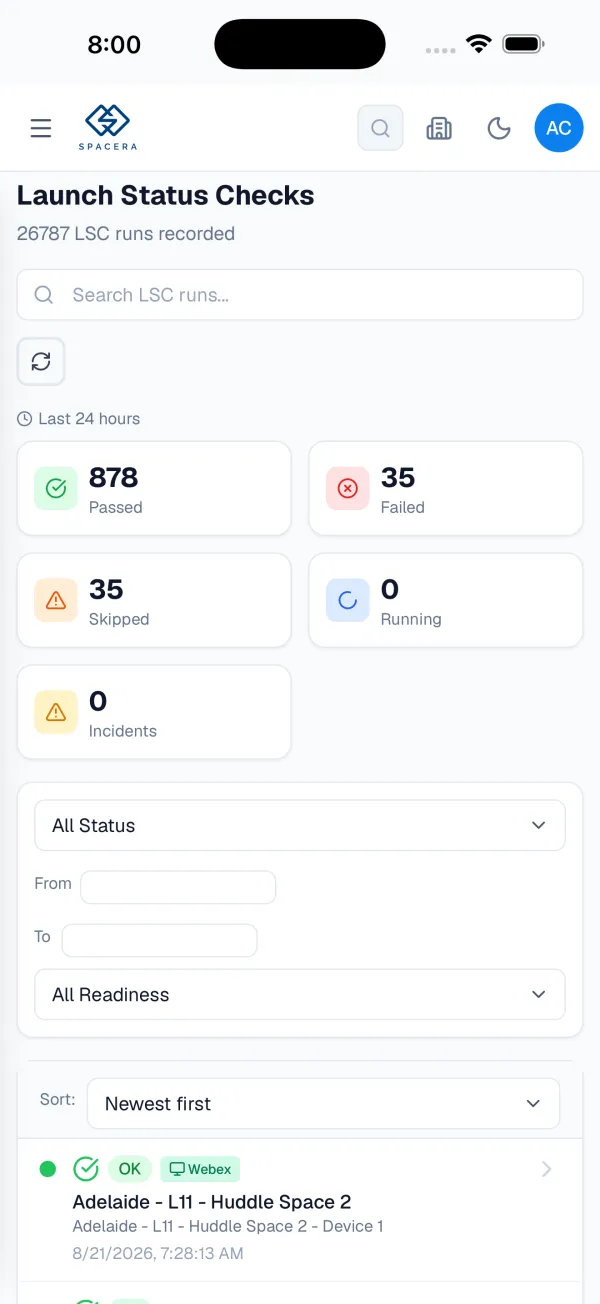
Spacera app Launch Checks: this morning's passed, failed and skipped rooms

Without a morning check

  1. 8:55People arrive for the 9:00. The touch panel can’t start the call, or the room is silent when it connects.
  2. 9:00The meeting starts late, from someone’s laptop. Someone rings the service desk.
  3. LaterThe ticket says “Webex room not working”. An engineer walks over to find out why.

With Apollo

  1. Early morningApollo checks the device is free, wakes it, runs its built-in audio diagnostics, then joins it to a short Webex meeting. The Launch Check is scheduled before 6 AM local time.
  2. Fault foundThe test call’s audio is checked for packet loss, latency and jitter. Emily runs the fixes she can remotely and logs each one.
  3. Needs a personA ticket lands in your ITSM tool with the room, device and test results attached, and an alert reaches the Spacera app or Webex Messaging.

Launch Checks are scheduled before 6 AM local time, and nine in ten are done by 9 AM. Not sure how many of your rooms fail this way? Score them with the Meeting Room Reliability Audit.

Cisco-specific faults

Webex device faults Apollo catches, and what happens next.

Cisco devices tell Apollo more than any other room platform. Here’s each fault Apollo looks for, and what happens when it finds one.

Restarted overnight, or crashed

Cisco devices report how long they’ve been up and why they last shut down, which tells a planned restart from a crash or a power cut.

What happens. Apollo keeps that history, so a device that keeps going down shows up as a pattern, not a surprise.

A camera, panel or microphone drops off

Control Hub lists the peripherals connected to each Cisco device, each with its own serial number, status and software version.

What happens. A peripheral that disconnects shows on the room, not in a complaint. If it can’t be cleared remotely, the ticket names the device that failed.

Control Hub raises an error

Cisco publishes error codes and a lifecycle status for each device rather than a single traffic light, and they’re easy to miss in Control Hub.

What happens. Apollo shows them with the device, beside the morning test result. Control Hub alerts reach Apollo once your organisation sets up its Webex webhook.

It connects, but the audio is poor

The device joins, but packets are lost, or latency and jitter are high enough to make a meeting hard work.

What happens. The Launch Check runs the device’s own audio diagnostics first, then raises high loss, latency or jitter on the test call, or media that has fallen back from UDP, as an incident.

Muted, or turned right down

A room left muted, or with the volume at its lowest, works perfectly and sounds broken.

What happens. Apollo reads volume and mute state from the device, so you can see it before the meeting does.

Stuck in yesterday’s call

A device that never hung up from yesterday’s call can’t take today’s.

What happens. The Launch Check sees the call and leaves the device alone. Administrators can end a stuck Webex call from Apollo.

Device actions on Cisco include restarting Room Bar, Room Kit, Board and Desk devices in Webex or Teams Rooms mode, and sending logs to Cisco with the log ID for a TAC case.

Beyond Control Hub

What Apollo adds to your Webex devices

Control Hub tells you how a device is. Apollo proves each morning that it can take a call, then puts the result where your service desk already works.

Every morning

  • A test call every morning. A Launch Check on every device you enrol, with a real Webex meeting that proves the room can join and be heard.
  • Automation first, people next. Emily logs every fix she runs; what she can’t clear goes to a person with the diagnosis. HyperCare adds a 24×7 human service desk, L1–L3.

Where your team works

  • Tickets where your team works. Ticket integrations cover ServiceNow, Jira Service Management, Freshservice, BoldDesk and ConnectWise, with Zoho Desk setup available through your Spacera partner. Your partner will confirm the workflow included in your service.
  • Alerts in your channels. Push alerts in the Spacera app that open the affected room, messages in Webex Messaging, and 13 channels in all.

Across every room

  • Every other room. Microsoft Teams Rooms and Zoom Rooms, plus Neat, HP Poly, Logitech, Yealink, Crestron and Q-SYS, in the same dashboard. Google Meet and Jabra hardware join as imported inventory.
  • Reliability reports. Across every room, whatever platform it runs.

What Apollo sees

What Control Hub shares with Apollo, and what it needs.

Knowing the limits matters as much as the list. Here’s what reaches Apollo from each Cisco device, and what has to be in place first.

From every linked device

  • Connection status, refreshed about every 2 minutes, and detailed device state about every 5
  • Software version, serial number, IP and MAC address, and the upgrade channel the device follows
  • Uptime, and the reason and time of the last shutdown
  • Connected peripherals, each with its own serial number, status and software version
  • Volume and mute state
  • People count and presence, plus temperature, humidity and an air-quality index on devices with the sensors

What it needs

  • Devices linked to Webex Control Hub. A device registered only to Microsoft Teams shows as a Teams Room, with little Cisco detail
  • A Webex webhook, set up once per organisation, for Control Hub alerts to reach Apollo
  • Launch Checks switched on device by device, so you choose which rooms get the morning call

Sensor readings depend on the device model. Cisco reports an air-quality index rather than separate CO₂ and VOC readings.

How it works

Webex Control Hub integration in minutes. No agents.

Start with free visibility, add the morning test when you want the broken room found for you, and hand the whole fleet over when you’d rather not run it yourself.

  1. Approve access

    A Control Hub admin connects Apollo from Fleet, Add Platform, Cisco Webex, and authorises it with OAuth. Devices appear within minutes, with nothing to install in the room.

  2. See every device, free

    Every Cisco device linked to Control Hub, with its peripherals, versions and errors, in one live dashboard, read-only on Photon.

  3. Test and fix every morning

    Mission Control adds Launch Checks, Emily and tickets with diagnostics, at US$35/room/mo. A partner can switch on a 30-day trial on your own rooms.

  4. Hand the rooms over

    HyperCare Managed adds a 24×7 service desk, L1–L3, with RMA and vendor management and preventative maintenance, at US$80/room/mo.

Mission Control and HyperCare Managed are bought through a certified Spacera partner, together with AV integrators, MSPs and telcos. Installing Cisco rooms for clients? How AV integrators sell Apollo.

Questions

Webex devices, answered.

How does Apollo connect to Cisco Webex devices?

Through Webex Control Hub, cloud-to-cloud. A Control Hub admin authorises Apollo with OAuth, and the Cisco devices registered there appear within minutes. There are no agents, no hardware and no network changes. Detailed permission and architecture documents are shared under NDA.

What does the morning Launch Check do on a Cisco device?

Apollo first checks the device isn’t in a call and, where it reports people presence, that the room is empty. It wakes the device, runs its built-in audio diagnostics, then joins it to a short Webex meeting as host, confirms the call connected, holds it for about a minute and hangs up. The call’s audio is checked for packet loss, latency and jitter. Launch Checks are scheduled before 6 AM local time, and nine in ten are done by 9 AM.

Do Launch Checks run on every Cisco device?

Only the devices you enrol. Launch Checks are switched on device by device, so you choose which rooms get a morning test call. Every device linked to Control Hub still gets live health.

Our Cisco devices run Microsoft Teams Rooms. Does Apollo still see them?

Yes, as Teams Rooms. Link them to Webex Control Hub as well and Apollo keeps the Cisco detail too: peripherals, uptime and the reason for the last shutdown. A device registered only to Teams shows as a Teams Room with little Cisco detail.

Which Webex device faults can Apollo fix without a person?

Emily, Apollo’s automated L1/L2 technician, handles faults such as configuration drift and sign-in failures remotely, and logs every action. Nine in ten of the faults Apollo raises are resolved without a human touching them. (Random sample of Apollo-raised service requests, August 2026.) Faults she can’t clear, such as failed hardware, go to a person as a ticket with the room, device and test results attached.

Does Apollo record our meetings?

No. Apollo stores device telemetry — health, status and configuration — encrypted at rest in Microsoft Azure. Apollo uses Microsoft Azure. EU, UAE and US telemetry regions are planned, not generally available; confirm the available region and your residency requirements with us before onboarding. It does not record or read your meetings. OAuth tokens are encrypted and you can revoke them from your admin portal at any time.

What does Webex device monitoring cost?

Photon is free forever: live health for every Cisco device, with read-only access. Launch Checks, Emily and tickets come with Mission Control at US$35/room/mo. HyperCare Managed adds a 24×7 L1–L3 service desk at US$80/room/mo. Mission Control and HyperCare are bought through a certified Spacera partner.

Cisco Collaboration Select accredited.

Spacera is a Cisco Collaboration Select accredited partner. Built with Cisco's enterprise API ecosystem. Apollo connects to Webex devices through Control Hub, with access your admin approves.